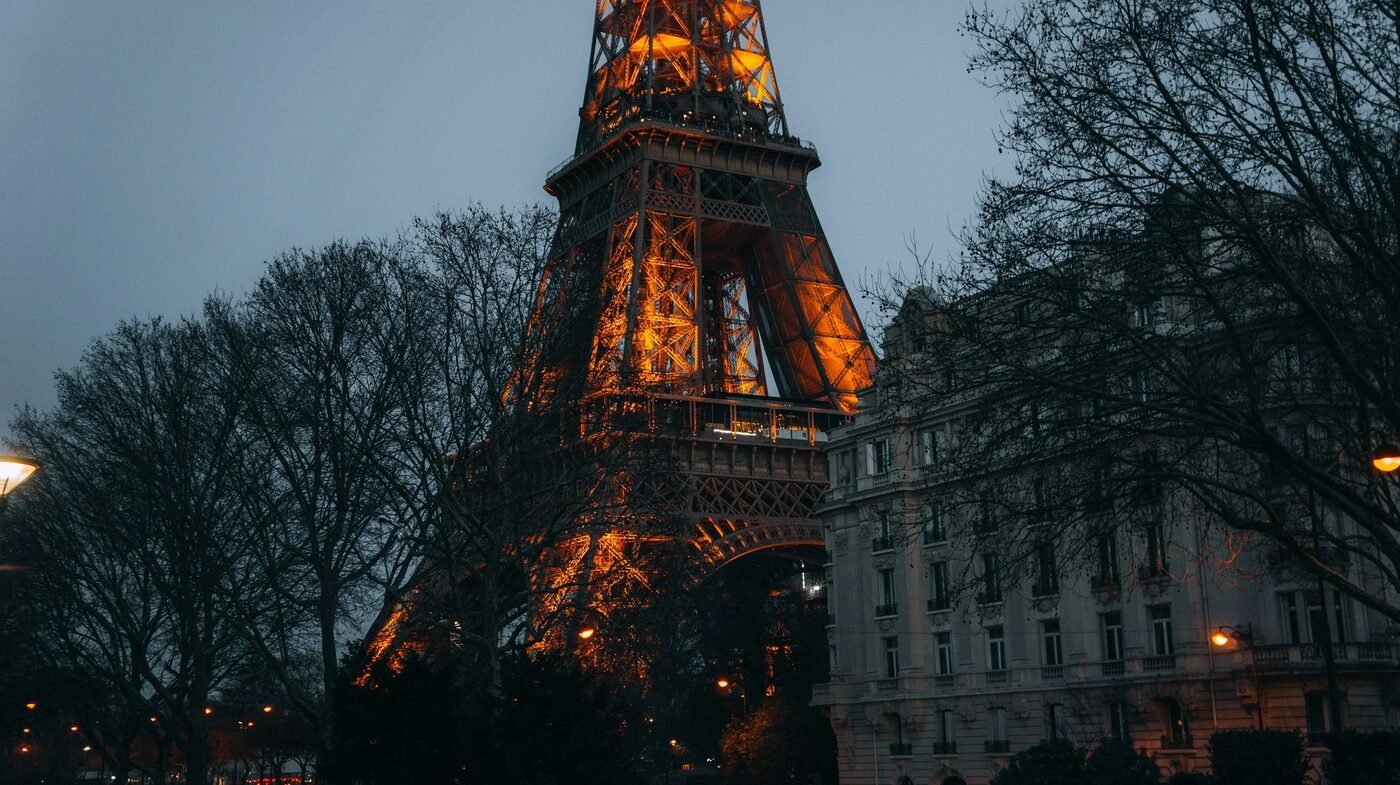
The Eiffel Tower and The Films That Made (and Still Make) You Want It

Travel Writing from The Most Perfect View
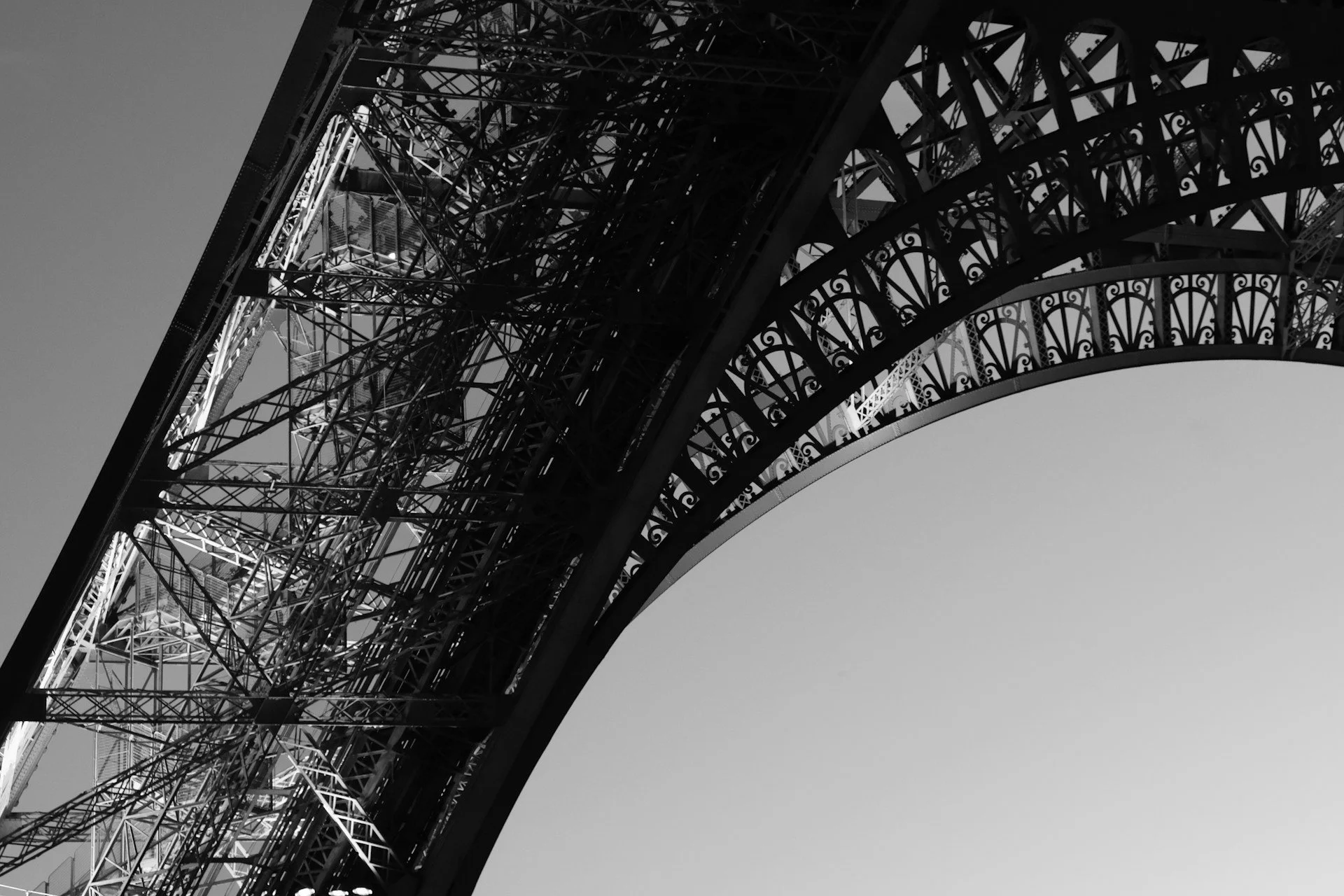
The Eiffel Tower and The Films That Made (and Still Make) You Want It
From a child's first tears to Carrie Bradshaw's balcony scream — how cinema built the world's most desired view, and where to finally live it.

There was something about that structure that wouldn't fit inside a child's eyes.
I remember looking up and not being able to find the end of it. It was too large, too improbable, too real to be true. I started crying — not from sadness, but from the kind of awe that a child's body doesn't yet know how to process in silence. My father took me to the top. And from up there, Paris opened up like a promise I'm still keeping today.
That moment never left me. And I've come to understand, over the years, that it isn't particular to me. There is something about the Eiffel Tower that provokes exactly this — a reaction disproportionate to what any iron structure should be capable of producing. The question is understanding why.
The Tower and Cinema Were Born at Almost the Same Time
The Eiffel Tower was inaugurated in 1889. The Lumière brothers' cinematograph arrived in 1895. Six years apart — and by 1897, someone was already riding the tower's elevator with a camera in their arms.
The film is called Panorama pendant la montée de la Tour Eiffel and runs 42 seconds. It shows the Trocadéro Palace receding as the camera climbs, the iron structure framing everything like a window in motion. It was filmed just eight years after the tower's inauguration — at a time when Parisians themselves hadn't yet made peace with it.
Because Parisians, it must be said, hated the Eiffel Tower. When Gustave Eiffel presented the design for the 1889 World's Fair, the criticism was ferocious. They called it an "iron wart," a "grotesque candelabra," a "skeleton of a belfry." Guy de Maupassant regularly lunched at the restaurant on the second floor — according to legend, because it was the only spot in Paris from which he couldn't see it.
And yet. Today it is the most sought-after view in the world. The most photographed, most filmed, most desired monument on earth. The irony is complete: the structure Paris wanted demolished became the symbol of France itself — and of the very concept of European elegance in the global imagination. Cinema had a great deal to do with that journey. But the tower already had, on its own, the power to create that fascination — as I discovered myself as a child, long before I'd ever seen it on a screen.
What the Screen Did to the Tower
There's a question worth asking: why do millions of people book hotels in Paris specifically to see the Eiffel Tower from their window? It isn't the city's oldest structure, nor its most ornate. But it's the one everyone wants to see from their room.
The answer has two parts. The first is the tower itself — especially when lit at night, its hourly sparkle does something to the human eye that is difficult to explain rationally. It may be the only landmark in the world capable of producing a genuinely involuntary reaction in people who see it for the first time: a sharp intake of breath, an unplanned exclamation, sometimes tears. The second part is cinema: 130 years of films that have taught us what to feel when we see it.
And cinema didn't teach us one emotion. It taught us all of them.
It's pure romance in Funny Face (1957), when Audrey Hepburn dances on the tower's balcony with Fred Astaire and Paris feels like a musical that will never end. It's childhood adventure in Superman II (1980), when the Man of Steel flies toward Paris to prevent an explosion — the tower as the coordinates of salvation, as it had to be. It's vertigo and action in A View to a Kill (1985), when May Day leaps from the top with a parachute and James Bond chases her down the stairs. It's intellectual melancholy in Midnight in Paris (2011), when Owen Wilson wanders the streets at midnight and the tower illuminates a city that belongs to the past. It's magic in Moulin Rouge (2001), when Ewan McGregor's voice literally lights up the tower as he sings to Nicole Kidman, and the couple twirls up into the clouds.
In Amélie (2001), the tower exists as the affectionate backdrop of an interior, almost dreamlike Paris. In Paris, Je T'aime (2006), a pair of mimes find each other in the nighttime shadows near the tower in a scene that exists outside time and language. In Ratatouille (2007), the tower appears as the warm backdrop of a Paris that only exists in Pixar's imagination — and yet we recognize every street.
"The tower doesn't have one emotion. It has all of them."
It's a canvas onto which cinema has projected everything human beings feel. When someone finally arrives in Paris and opens the hotel curtain, they aren't living a secondhand emotion. They are fulfilling something they imagined. The desire is genuine — built over years, screen by screen. And when the tower is there — lit, enormous, improbable — reality exceeds the promise. Always.
The Hotels Where the Scenes Were Filmed
Some of those films chose real hotels. And those hotels have real views — and balconies where the story can repeat itself.
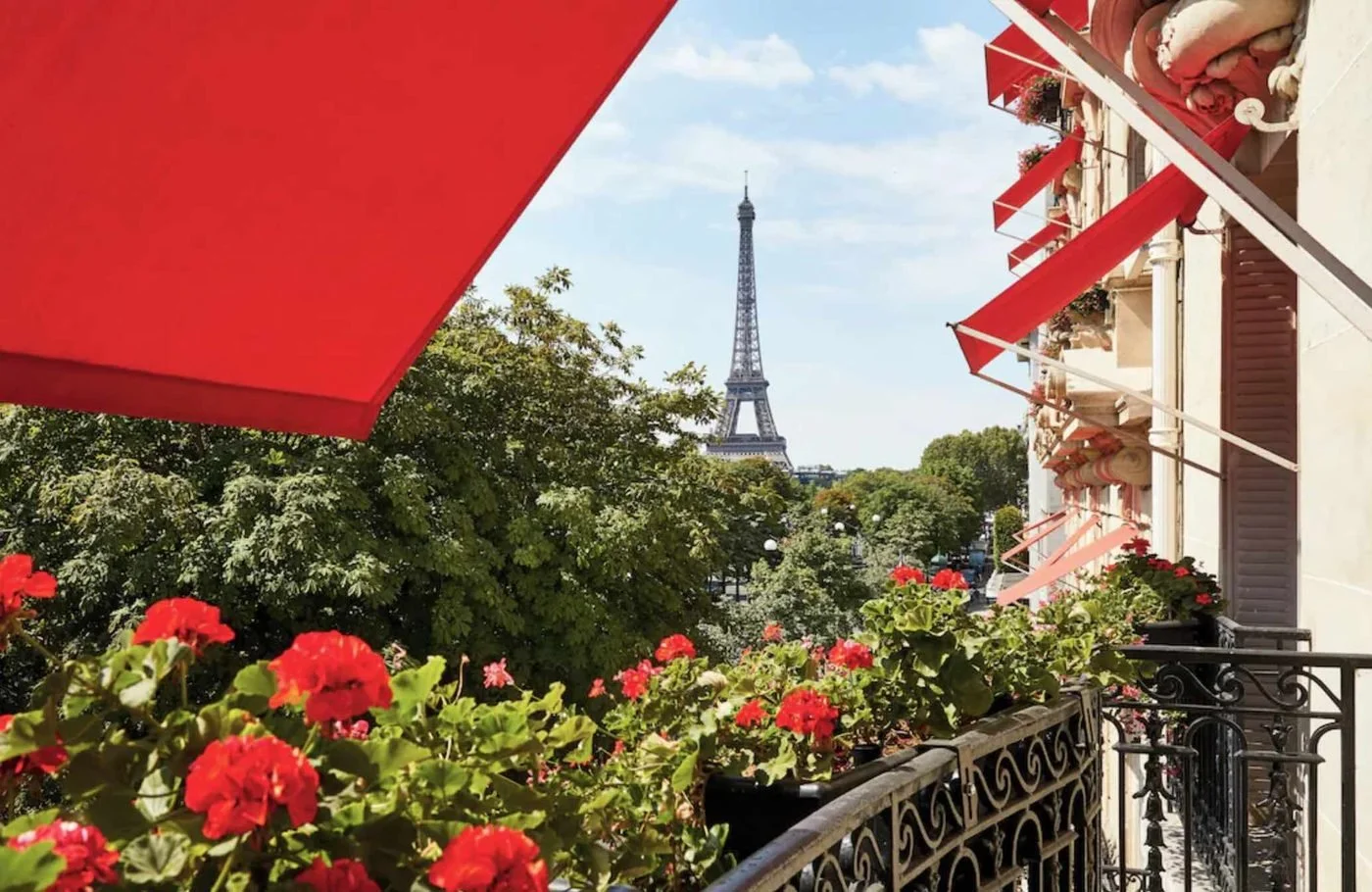
In the final episodes of Sex and the City, Carrie Bradshaw arrives at Hôtel Plaza Athénée — its facade with iconic red awnings on Avenue Montaigne a Paris landmark in its own right. When she opens her curtains for the first time, she looks left. Nothing. Then she turns right, and there it is: the Eiffel Tower, filling the frame of her balcony. What follows is one of the most honest reactions in the history of travel television: dressed in Sonia Rykiel, she screams, starts clapping, and jumps up and down with joy. No composed observation. No considered reflection. Pure, uncontrollable elation.
The suite where it was filmed is now unofficially known as “the Carrie Bradshaw suite.” The view is real but exclusive: only select rooms on the 7th and 8th floors carry it.
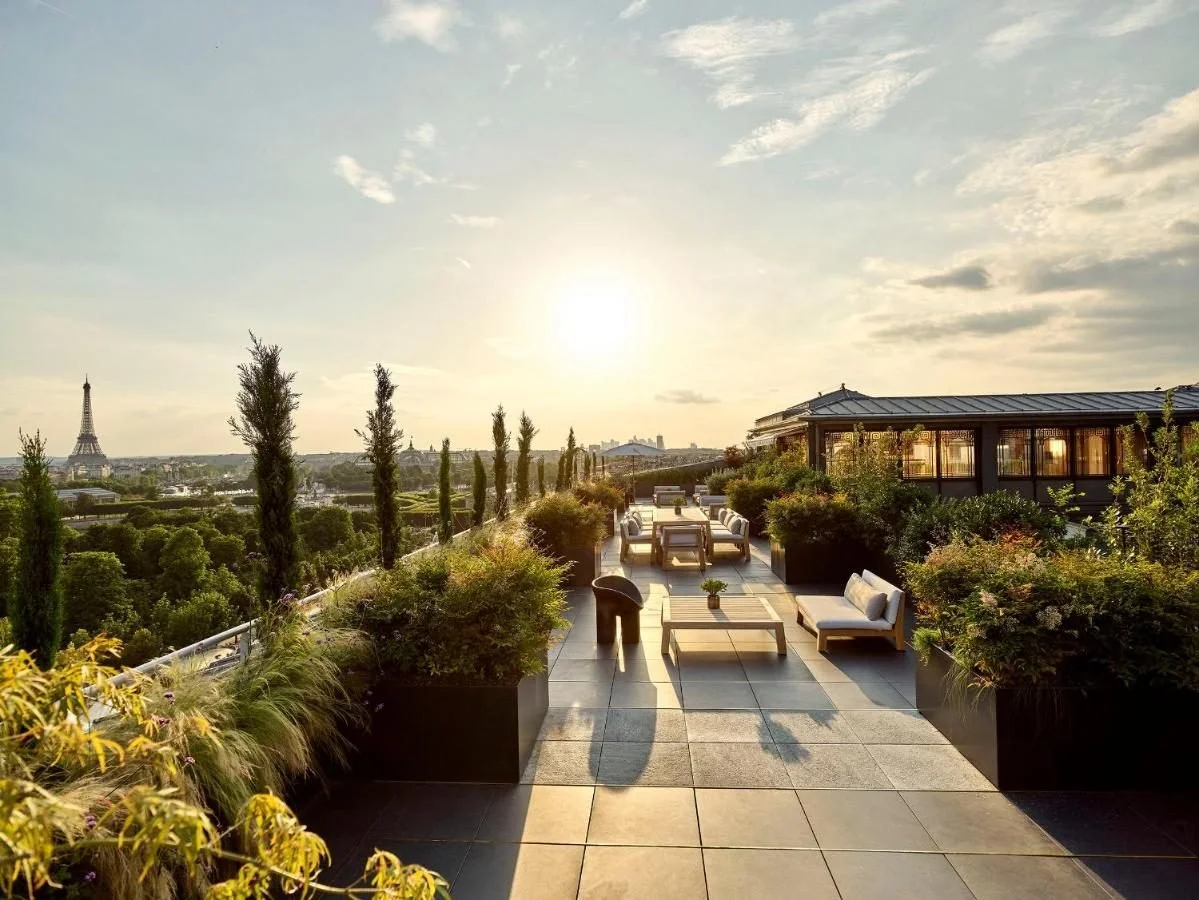
Midnight in Paris found its setting at Le Meurice. The wine tasting scene — Gil Pender surrounded by Paris at dusk, the whole city opening up beneath him — was filmed on this terrace above the Rue de Rivoli. The Belle Étoile Suite on the top floor offers a 360-degree view that makes the scene entirely believable: the tower appears on the right, the Louvre on the left, the Seine shimmering in the distance. Woody Allen chose this address deliberately. It is the kind of place that still believes Paris belongs to anyone willing to sit still for long enough.
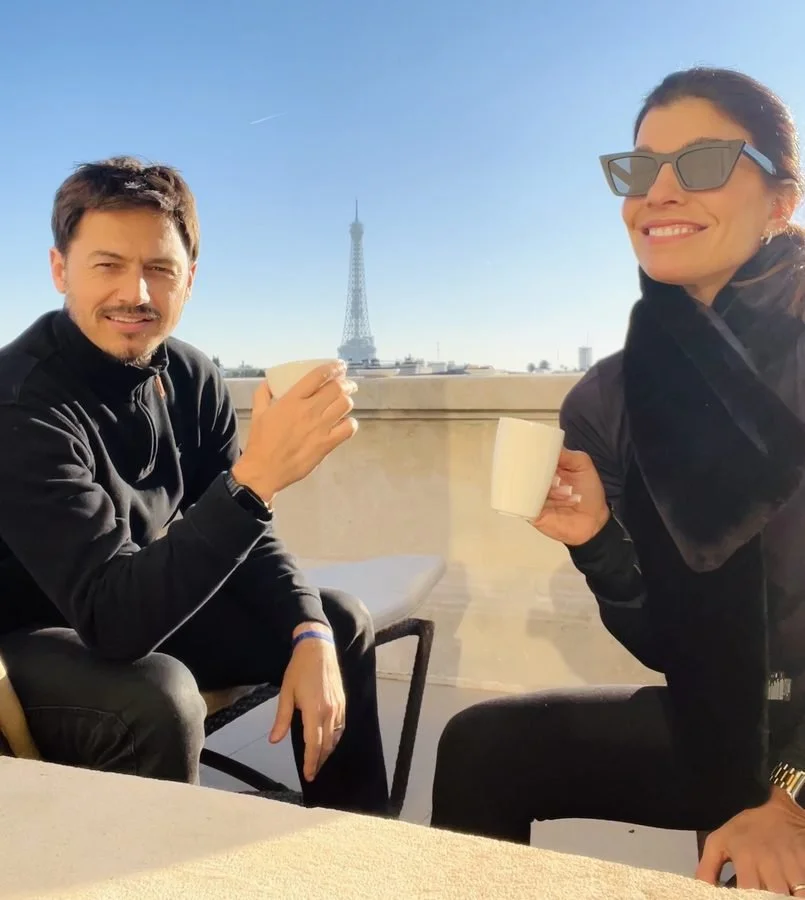
Then there is Hôtel Raphael — the hotel from Hotel Chevalier (2007), Wes Anderson’s twelve-minute short with Natalie Portman, filmed entirely inside the property. The tower doesn’t appear on screen. But what the film couldn’t show, the hotel delivers in full. I’ve stayed here, in the Eiffel Tower Terrace Suite — a private L-shaped terrace larger than many Paris apartments, with the tower directly ahead, the Arc de Triomphe to one side, and the distant dome of Sacré-Cœur closing the horizon.
I remember waking early one winter morning during that stay. The sun hadn’t risen, but the sky had already begun to lighten. I stepped outside in a bathrobe — temperatures near freezing, the city completely still — and spent a long while watching Paris wake up slowly, with the tower present the entire time. It was, without qualification, magical. And as a footnote: the room next to mine had been a favourite of Coco Chanel, who stayed there regularly. Some hotels carry their history quietly. The Raphael is one of them. The hotel closed in 2024 for renovation and is expected to reopen in late 2026 — worth keeping on your list.
Before You Go: Every Film Worth Watching
No exclusions. Every film on this list shows Paris the way it deserves to be shown — with respect, with light, and with the tower somewhere in the frame.
-
Under the Eiffel Tower
2019
A man proposes to his best friend's daughter at the foot of the tower. She says no. The film follows what happens next. Quietly funny.
-
Mission: Impossible – Fallout
2018
The Paris sequence — helicopter, rooftops, the tower in the background of a city that is about to be destroyed. Cinema at full velocity.
-
Midnight in Paris
2011
The definitive case for nostalgia as a way of life. Owen Wilson walks into 1920s Paris at midnight.
-
Hugo
2011
Scorsese makes a film about a child in Paris — a declaration of love for cinema itself.
-
Ratatouille
2007
An animated Paris with the tower above a kitchen that Pixar made feel entirely real.
-
Rush Hour 3
2007
Jackie Chan and Chris Tucker take Paris at full speed. The finale plays out on the Eiffel Tower — loud, silly, and surprisingly committed to the bit.
-
Hotel Chevalier
2007
Wes Anderson, Natalie Portman, the Hôtel Raphael. Twelve minutes. The tower doesn't appear.
-
2 Days in Paris
2007
Julie Delpy films a couple walking Paris and arguing. The most honest version of Parisian romance.
-
Paris, Je T’aime
2006
Twenty-two directors, twenty arrondissements. A pair of mimes near the tower in a scene outside time.
-
Before Sunset
2004
Two people walk all of Paris in real time, talking. The tower is never the subject — it’s just always there.
-
Sex and the City
2004
Technically television. The Plaza Athénée balcony scene counts as cinema for all practical purposes.
-
Amélie
2001
Jean-Pierre Jeunet’s interior Paris — warm, precise, slightly imaginary.
-
Moulin Rouge
2001
McGregor’s voice literally lights up the tower. Baz Luhrmann at full intensity.
-
A View to a Kill
1985
May Day leaps from the top with a parachute and Bond chases her down the stairs.
-
Superman II
1980
The Man of Steel flies toward Paris — the tower as the coordinates of salvation.
-
Funny Face
1957
Audrey Hepburn dances on the tower’s balcony with Fred Astaire. Paris as a musical that will never end.
-
The Man on the Eiffel Tower
1949
A manhunt across Paris, the tower as both backdrop and trap. Charles Laughton as Inspector Maigret. The oldest film on this list with the tower at its centre.
The View That Didn't Happen — and What Came From It
Almost two decades after that first time as a child, I returned to Paris as an adult. I booked a hotel convinced I would wake up with the Eiffel Tower in front of me. Instead, I found a wall.
The frustration was real. At the time, there was no reliable way to know which hotels actually offered a view of the tower — let alone which specific rooms within those hotels had it. I had booked in good faith, and received a wall in return.
It was that frustration that led to the creation of The Most Perfect View in 2010. The idea was simple: build the resource I needed and couldn't find. Since then, thousands of people have consulted our pages looking for exactly the same thing — the right room, with that view, in that city.
The tower that Parisians wanted torn down became the symbol of the world. Cinema spent 130 years amplifying that power. And the moment it delivers — when you open the right hotel curtain, turn right, and there it is — the only possible response is the one Carrie Bradshaw had on the balcony of the Plaza Athénée.
You clap. You jump. You make a sound that isn't quite a word.
Which is, it turns out, exactly the right response.